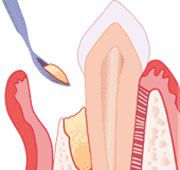
 Placing synthetic bone
Periodontal Surgeries
Regeneration Surgeries
The ideal outcome in the treatment of periodontal disease is to return the tissues to their original state, as they were before the infection started. While we cannot do this with all cases, today more and more pockets can be restored, at least partially, with regenerative surgery. There are three primary types of regenerative surgery:
1. Bone Grafting
What is bone grafting?
The oldest technique used in regeneration surgery calls for placing various materials in the bone defect, to stimulate the patient's bone to re-grow.
Bone grafting has been used for over 75 years, but today's materials are much superior in stimulating new bone to form.
The implanted material is resorbed by the body, and after 6-12 months has completely disappeared, replaced by new bone. Various materials are available, with the selection made on a case by case basis.
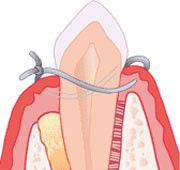
Synthetic bone placed in defect
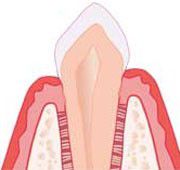
Synthetic bone stimulates patient's natural bone to regenerate
2. Guided Tissue Regeneration
What is Guided Tissue Regeneration?
A more recently developed type of regenerative surgery depends on guiding the proper tissue to heal the periodontal lesions. Gum tissue heals very quickly, and after surgery migrates down into the bone pocket quickly. Unfortunately, this does not allow time for the bone to refill the pocket, so the defect persists. With guided tissue regeneration, the gum tissue is excluded from the bone defect with a resorbable membrane, allowing time for the bone to fill back in. This technique has been available for 18 years, and in certain areas is extremely predictable.
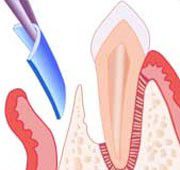
Defect
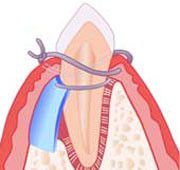
Membrane isolating defect so bone has time to heal
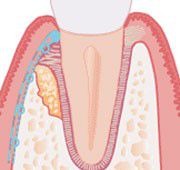
New bone forming as membrane dissolves
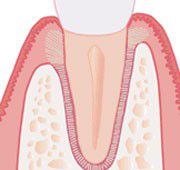
Final Healing
3. Cell Stimulation
What is Cell Stimulation?
The most recent development in periodontal regeneration is the use of proteins to induce the formation of tooth supporting structures lost to periodontal disease. Available since 1999, the procedure calls for placing embryonic cells into the defect, which in turn stimulate production of new bone and tissue cells which reform the normal periodontal complex. These cells are porcine (pig), and carry no risk of disease transmission. While long-term studies are not yet available, the research to date warrants use of this approach under certain circumstances. (See Emdogain below)
The dentist must decide in each case whether the chances of improvement warrant the added expense of bone regeneration. However, restoring bone and the periodontal complex is the gold standard, and periodontal regeneration is being used more and more.
4. Emdogain
What is Emdogain?
Emdogain is a recently introduced product that fools the body into forming new bone, cementum, and attachment fibers. Technically, it is enamel matrix proteins (amelogenins) that are taken from developing teeth in pigs. These proteins are similar in all mammals, and humans do not recognize them as foreign. There is also no chance of transmission of any bacteria or virus by the proteins. In tooth development, the secretion of these proteins onto the developing root surface precedes the formation of tooth attachment. A similar action occurs when the proteins are placed on a root surface that has lost bone and attachment from disease. When applied to the root surface during surgery, these proteins assemble into an insoluble matrix layer that promotes the attachment of mesenchymal cells. These cells produce new matrix components and growth factors that participate in the regain of tooth attachment. Emdogain also inhibits epithelial cell growth that could interfere with proper tissue and bone reformation.